
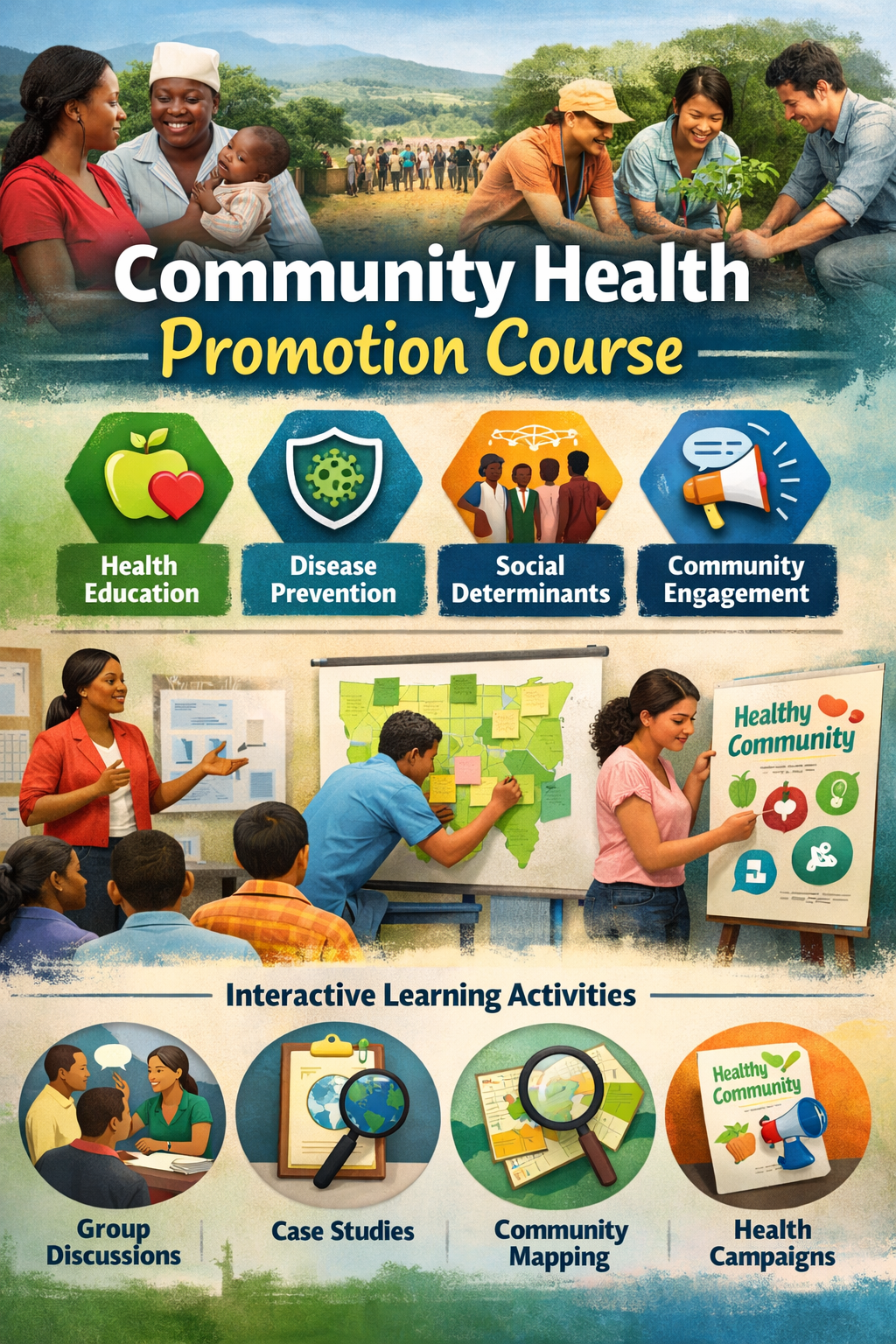
Community Health Promotion
Community Health Promotion is an introductory course designed to equip trainees with knowledge and practical skills to improve health and wellbeing at the community level. The course explores the principles of health promotion, disease prevention, social determinants of health, and community participation. Trainees will examine how education, behavior change, policy, and community empowerment can be used to address public health challenges and promote healthy lifestyles in diverse populations.
Learning Outcomes
By the end of the course, trainees should be able to:
- Identify key social, cultural, and environmental factors that influence community health.
- Explain the core concepts and principles of community health promotion.
- Analyze common public health challenges and appropriate health promotion strategies.
-
Design basic community health promotion interventions and educational messages.
-
Demonstrate effective communication and advocacy skills for health education.
-
Appreciate the role of community participation and partnerships in promoting sustainable health outcomes.
Interactive Learning Activities
-
Group Discussions: Trainees discuss real-life community health issues (e.g., sanitation, nutrition, maternal health) and propose promotion strategies.
-
Case Studies: Analysis of successful community health promotion programs at local or global levels.
-
Role Plays: Simulated community outreach sessions or health education talks to practice communication skills.
-
Community Mapping Exercise: Identifying health resources, risks, and stakeholders within a community.
-
Mini Project: Designing a simple health promotion campaign (poster, talk outline, or social media message).
-
Reflection Journals: Trainees reflect on community health challenges observed in their own communities.
- Teacher: Admin User